


Ay Unaonth Pan-Cheltadh (Standardised Celtic)
An Aontas Pan-Cheilteachas (Gaelige)
An Aonadh Pan-Cheilteach (Gàidhlig)
An Aontaigh Pann-Cheiltagh (Hibernian/Goidelic Fae)
Y Unnaneys pan-Cheltiagh (Gaelg)
Y Undeb Pan-Geltiaeth (Cymraeg)
An Unyans Pan-Keltek (Kernowek)
Unanadur Pan-Keltaidd (Brezhoneg)
A Unión Pancéltica (Galego)
A União Pan-Celta (Português)
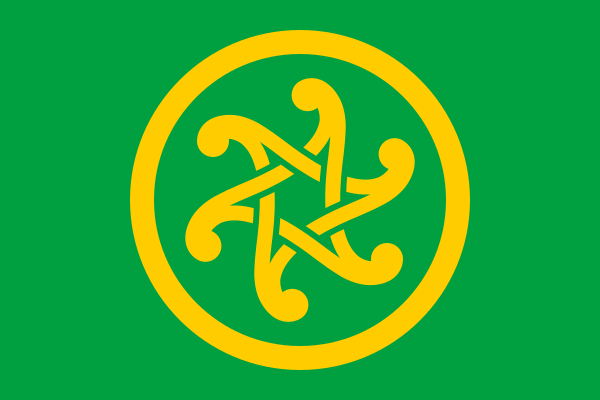
Basic information
| Largest City: | Baile Átha Cliath/Lisboa |
| Official Languages: | Standardised Celtic ' Irish ' Scots ' Fae ' Manx ' Welsh ' Cornish ' Breton ' Galician ' Portuguese |
| Ethnic Groups: | 61.7% Celtic White 13.4% Mi'kmaq 8.1% Other White 7.2% Other Canadian Indigenous 4.2% Asian 4.1% Black 2.3% Other |
| Religion: | 1916 |
| Denonym(s): | 3 658 km2 (Pocket dimension) 294 km2 (City) |
| Government: | 104 341 (2022) (Total) 41 736 (Fae) 31 302 (Yeren) 21 068 (Humans) 10 235 (Other) |
| Area: | 355/km2 |
| Population: | Polish English Fae Yeren |
| Currency: | Złoty (PLN) Euro (€) (EUR) |
Detailed information
| Date Format: | UTC+1 (CET) |
| Founded: | UTC+2 (CEST) |
| GDP: | 97 AP/I1 |
| HDI: | 6.17m |
| Timezone: | UST/UST-4 UST+1/UST-3 |
| Internet TLD: | .ce |
https://commons.wikimedia.org/wiki/File:Candle-light_-_Lorc_-_game-icons.svg
https://commons.wikimedia.org/wiki/File:Banniel_Keltia.svg


Pan-Celtia, also known as the Pan-Celtic Union, is a country in west Europe comprising the former nations of Ireland, Hy-Brasil, the Isle of Man, Scotland, Wales, Cornwall, Brittany, Portugal and Nova Scotia.2 The state lacks a formal capital city, with each member nation declaring an individual city and local government, with the largest of these being Lisboa. The state borders Britannia in the English Archipelago, the New Dawnland Confederacy in Atlantic America, Chantli Itzatlacameh in Iberia, the Kingdom of France of Communes of Paris in France and Carthage in the North Atlantic. It is a federal, semi-presidential republic.
The Pan-Celtic Union was initially proposed by the Kingdom of Ireland in 1950, shortly after Brittany and Scotland broke away from France and Britannia respectively during the Second Benthic War, being first formed in 1951. From 1952 to 1968, several more Celtic nations would join the state, leading to its formal creation and recognition by the Global Organization of Countries as a state. As part of the Kindred Deal of 1974, Nova Scotia would become part of the state after being purchased from the New Dawnland Confederacy.